PTSD- The Invisible Disability
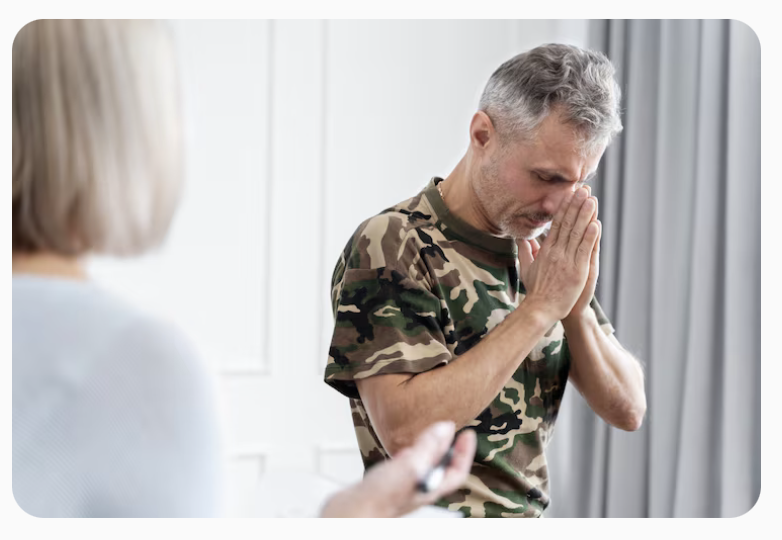
All through our married life, we tried to have dinner about the same time in the early evening with all five of our children around the table. It was wonderful —-and sometimes chaotic. When the sounds of all the children talking at once got too much, Charles would holler loudly above the noise, and tell everyone to ‘be quiet and eat’!
The children and I got used to that. They still shared about their school day or whatever was happening in their lives, but it was done in a much more subdued atmosphere.
INSTANT WEATHER CHANGE
But then would come the moment, when quite unexpectedly, one of the kids would hit their glass of tea, water, or milk and it would clunk onto the table and fluid would go everywhere.
In that moment it was nothing less than an instant weather change! Before a word could be spoken there was a thundercloud response from their dad, with shouting! I would quickly rise and assure the child and… Charles that it was fine. I’d get the mop or towel and clean it up. It was just a drink, nothing broken and not a big deal.
CONFUSING EMOTIONS
Meanwhile the child was nearly shaking with fear— trembling and apologizing profusely, over what had simply been an accident.
Charles on the other hand, was still trying to rein in his emotions from sensory overload. What he heard and saw wasn’t a glass tipping over. His system was telling him there was an attack and his nervous system went into “brace for impact, there’s danger!”
The unexpected movement, sharp sound, surprise, mess and chaos, —-even my rising, to take care of it, —was more than his mind, at that moment, could handle.
Then there were layers beneath it all, as he’d stare at his plate when cleanup was done, and he’d say, “Just eat your dinner.” At that moment perhaps his own heart was wondering why he had exploded that way, and scared the kids? Why was he so unable to keep from over reacting, at even the simple things? Perhaps he even feared, this part of himself might get worse?
A HIGH STRESS LEVEL
Dealing with this ‘unknown trigger’ kept our home at a high stress level. I could only describe it as, the children and I ‘walked on eggshells’ because we could never figure out what the next ‘trigger’ would be. It often caught us unaware, because there were times, when the same incident didn’t cause the ‘immediate weather’ change at all.
But we were forever ready for the thunderstorm, when something unusual happened. Some days it was more of a mood…. melancholy, sad, lost in his own world, or even a form of escapism from time to time.
WONDERFUL MOMENTS
And then he was wonderful. Everything about him was warm and welcoming…. until the next incident.
TRAINED FOR BATTLE
People talk about ‘the invisible disability’. Our family lived it for four decades and we didn’t have a name for it! Charles was in the Marine Corps, demolition expert—on the ground. He blew up ‘land mines’, among other things. He was in numerous combat situations and saw his comrades beside him fall. How can you not be affected by that?
‘IT’ HAD A NAME
But we didn’t know. For years neither he nor I knew he had PTSD. It wasn’t something anyone even talked about. His reaction to events like these left us confused, on some levels afraid, exhausted, and out of control.
It’s interesting to note, that I recall sporadic events when Charles and I first married back in 1973. As the years passed the ‘events’ became more frequent, and more intense. By the time he finally got diagnosed with PTSD forty years after we were married, it had gotten so much more intense.
Our community didn’t know. Most of the time, especially at work, Charles could control his environment and he was fine. Here in our home, with children all around, while he was never physically abusive, life could at times feel emotionally explosive. We were all grateful when he was finally diagnosed and received the help he needed.
STUDIES SHOW WHAT WE LIVED
In 1988 there was a study on the Vietnam era to find the prevalence of postwar psychological disorders. At the time it seemed to indicate most Veterans were successfully adjusting to normal life. Another study shortly after, showed an increase in PTSD and life-adjustment problems. By 2003 they reassessed their previous findings and found that those interviewed even 20-25 years later, the increase of PTSD was much higher than previously thought.
PTSD was ‘an invisible disability’ in our home for years. We lived it long before we ever had a name for it. After Charles got the help he needed, things were different…better. Not perfect— he still battled— but the last ten years we had, were probably our best. And that matters.
Photo Credit: PTSD